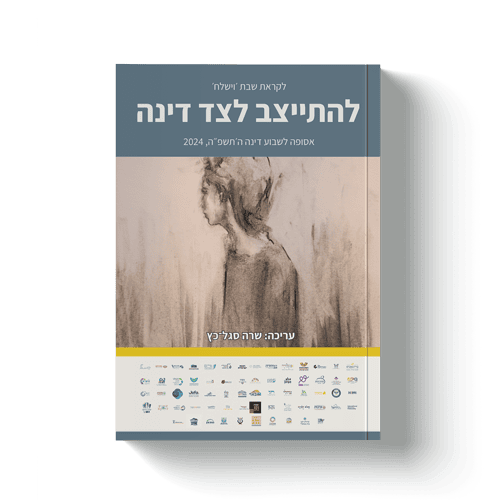


דרשה לשבת דינה – באנגלית – מאת הרב קייטי גרינברג, מבית הכנסת SCAIR בניו יורק. הדרשה קוראת להחזיר לדינה את הקול.
באמצעות מדרשים עכשוויים, שירה עכשווית וקריאה עם ערכים מהזמן הזה, הרב גרינברג מציעה מודל של תגובה אוהבת וחומלת לטראומה נוכח אלימות מינית: מיקוד בניצול/ת ולא בכבוד המשפחה, תשומת לב לאדם ולא לאירוע. כקהילה, דורשת הרב גרינברג, אנו נקראות ונקראים לבנות מרחב בטוח ולתמוך בניצולים באהבה.
There is a deep power in using someone’s name. When we get greeted or acknowledged by our name it can feel like we are seen for all that we are. When we are not, it can feel dismissive and disempowering.
Chanel Miller was in college studying at Stanford University when she was sexually assaulted at a party in 2015. The case became national news and she was only identified as Emily Doe in the case. People made negative many assumptions about her- who she was, what she cared about, how she moved in the world. Chanel decided to go public in 2019 and wrote a powerful memoir called Know my Name.
The book was Miller’s attempt to reappropriate her story and her identity after the press referred to her with derogatory terms. She wanted people to fully see her. To know she was a full human being. She was not only what happened to her. And that her story was hers. In the book she wrote, ““I did not come into existence when he harmed me. People said she found her voice! I had a voice, he stripped it, left me groping around blind for a bit, but I always had it. I just used it like I never had to use it before..” Chanel always had her voice and she was able to amplify that voice to the world. She was always a person with her own name and she reclaimed her own story. And she got people to listen to her.
That is not always the case when violence is perpetrated against people. Dinah, in our parsha, is sexually assaulted by Shechem, the prince of the city her family is visiting.
Unfortunately, we don’t get to hear her voice. She says nothing in this week’s parsha or anywhere in the Torah. In fact, no one even uses her name when speaking about her. She is just “our sister” or “the girl” or “your daughter. Only the narrator refers to her as Dinah.
Rabbanit Sarah Segal Katz and other leaders have called for our community to mark what she is calling Shabbat Dinah. This Shabbat congregations in Israel and around the world were asked to think about sexual violence and how to make our communities safer. They also ask that we say Dinah’s name. To remember her story. To give her a voice when the text gives her none. The tagline on the flier they sent out this year was “Dinah is one of ours”
I want to acknowledge that this topic is painful and hard to talk about. It is not theoretical but a lived personal experience for some people in this room. It is something that has happened to us or our loved ones. So be gentle with yourselves and those sitting next to you and take care of yourselves how you need during the next few minutes. According to RAINN, 1 in 5 women and 4% of men in the US have experienced sexual violence in their lifetime. As we know there are former Israeli hostages of both genders who were brave enough to talk about the sexual assaults they endured in captivity. This is not a single gender issue.
It’s a topic we don’t often talk about or acknowledge. It’s too painful, too personal, too difficult to face. Rabbanit Sarah Segal Katz is inviting us today to do what is hard. Rabbi Ayelet Cohen, the dean of the rabbinical school at JTS wrote, “ As painful and uncomfortable as the story of Dinah is, we must not ignore it or shy away from it. We must grapple with that text, and what it teaches us about the rabbinic understanding (or misunderstanding) of women’s experience and learn how we must repair what is damaged and missing.” So today I want to grapple with Dinah’s story and not to shy away from it.
I want to focus on her family and how they treated her after she was assaulted. Her brothers Shimon and Levi, decided to respond with extreme violence, killing not only Shechem, the perpetrator, but all the men in the whole city. They then take the women and children captive. They do not speak to Dinah at all in the narrative. No one asks her what she wants or what would help her heal. The brothers seem to be focusing on the fact that their family was dishonored and not that their sister was harmed. This is an extremely unhelpful response to say the least. It is focused on the brothers' reactions and not at all on Dinah.
I want to share two contemporary midrashim on the Dinah story that do a better job of bringing Dinah back into the narrative. Both posit that after she was raped, she became pregnant. They wonder what happened to her and her daughter. They give us pictures of who these two women were and that they were beloved by members of their family.
Yakov Azriel, a modern Israeli poet, wrote a poemcalled. “My Sister Dinah” about the relationship between Joseph and Dinah. He writes about a very sweet childhood that they shared. He depicts them playing with dolls they call Abraham and Sarah and studying with their father every morning and Jacob answers all sorts of philosophical questions. He imagined that they were very close as children because they were both isolated from their brothers and so bonded with each other. Azriel writes, “My brothers would laugh at me and call me a sissy,/ But I didn’t care, as long as Dinah agreed to play with me.”
The poem switches to what it was like for Dinah after what happened in Shechem. She no longer spoke. She was catatonic. Azriel ends the poem from Joseph’s perspective where he tries to connect with Dinah and bring her back to life.
Father thinks it’s hopeless.
But I don’t give up.
I talk.
Maybe she hears something.
Maybe she listens.
This morning I found the old dolls
And I’ve decided to bring them to Dinah.
I will be ‘Abraham’ again, she ‘Sarah,’
Maybe this way she’ll talk to me.
Only Father wants me to go up north tomorrow
And visit my brothers who are tending the flocks.
But as soon as I get back, I will bring the dolls to Dinah.
And I will get through to her.
I have to.
Because she just sits in the corner.
Rocking back and forth.
Holding her stomach.
Six months pregnant.
My sister.
Dinah.
This poem focuses on Dina’s devastation and Joseph’s devotion in bringing his beloved sibling some sense of connection. He cared about her and her psychological needs.
He hoped that maybe bringing her toys from their childhood would help remind her that there were times in her life that were joyous. He hoped she would see that he loved her no matter what happened to her. What is tragic, is that we know Joseph does not come home when he goes up North but is sold into slavery. He doesn’t get to come back to Dinah.
Azriel echoes the term Shimon and Levi use to refer to Dinah calling her their sister. They say “should our sister be treated like a harlot?” Though they are acknowledging she is kin, they don’t use her name and are not focused on her. In contrast Joseph, in the poem, uses the phrase “my sister” and follows it immediately with her name. By calling her Dinah he reminds her she is a whole human outside of her relationship with her big complicated family and outside of the violence that happened to her. In fact Azriel uses Dinah’s name 10 times in the poem. It’s a minyan of times that Joseph is acknowledging her for who she is.
In Azriel’s poem Dinah is pregnant. This is based on a midrash in pirkei d’rebbe Eliezer that says Dinah bore a daughter named Osnat. Dinah’s brothers again turned to violence and threatened to kill Osnat. Jacob wrote G-d’s name on a necklace and sent her away. Osnat ended up in the house of Potiphera and eventually married Joseph. Ayala Tzruya, who was a prominent Israeli educator, wrote a midrash published in the book Dirshuni expounds on the midrash in Pirkei D’rebee Eliezer. She explores what led to Dinah’s isolation and what Jacob’s relationship was like with Osnat. Tzruyah writes three times that no one spoke to Dinah.
No one spoke to her when she was young and that loneliness led her to want to seek out the daughters of the land to build connections with other people. The commentator Abarbanel notes that the word used for her seeing the daughters of the land has the same root that was used when Jacob sees Esau. Jacob was looking for connection with his long lost brother. Abarbanel wrote that just like her father, Dinah longed for connection and went to try to find friends among the women of the land.
The midrash continues that no one spoke to her after Shechem assaulted her and did not ask her what she wanted. Finally, they did not speak to her once she became pregnant and instead wanted to kill her and the child. The brothers didn’t let her name her child and instead they called her daughter Osnat so that Dinah would remember her disaster (ason) and her rape (ones). The brothers in Tzruyah’s reading have no empathy or compassion for Dinah.
Then Tzruyah rereads the famous line in our parsha and it says “And Jacob was silent” or “And Jacob took note” which is traditionally read as him being passive. He knew what was happening and he took no action to stop it or change course. But in this modern midrash, Jacob takes note of the name, and refuses to call his granddaughter Osnat. Instead he moves the letters around and calls her Atnes- you are a miracle. Like in Pirkei D’Rebbe Eliezer, Jacob wrote G-d’s name on a necklace and gave it to Atnes along with a coat of many colors to save her from his sons. Jacob treats Atnes as a cherished grandchild. Not only is she not “illegimate” in his eyes, she is so beloved that she too gets a coat of many colors. She is a miracle to him.
She goes on to be adopted by a royal Egyptian household and then married Joseph. If we combine the midrash and our previous poem this may have been a loving marriage. Joseph who knew how to love and care for someone who had gone through a trauma. He loved his sister for who she was and loved and appreciated his wife for who she is.
Tzruyah ends her midrash with Jacob on his deathbed blessing Ephraim and Menashe the sons of Atnes and Joseph. Jacob says in Genesis ch 34 that these two grandsons are like his own sons, that they are his. Jacob solidified that not only are Atnes’ children legitimate but they were beloved inheritors of our sacred tradition. Her offspring were solidly in the camp not outside of it.
Trzuyah’s midrash final line says “ A redeemer comes to Dinah” which is an allusion to Isaiah's prophecy, “And a redeemer comes to Zion” (Isa 59:20). Dinah and her daughter are not left behind in a story of pain and misery. They are brought in as essential and integral components to the story and legacy of Jacob and the Israelite people. This changes the arc of the Dinah story. It reminded me of a line from the passover seder where we say מתחיל בגנות ומסיים בשבח – We begin with degradation and conclude with praise.
Dinah’s story is transformed into one that begins with a horrible act and is able to end in redemption.
Tamar Biala in her commentary on Ayala Tzruyah’s midrash writes that “Truzyah highlights various human responses to rape and to the fruits of such an illicit union. Jacob's noble and impressive behavior becomes a model for others. He is not afraid of what other people will think; he acts independently to cleanse Osnat's reputation and secure her place in society, thereby sparing her from the fate that would otherwise have befallen her.” Jacob in this midrash, did not care about his reputation. He only cared for his granddaughter and made sure she not only found physical safety but was loved.
Jacob in Trzuyah’s midrash and Joseph in Azriel’s poem model compassionate loving responses to acts of sexual violence. They both centered the person and not only the action that happened to them. They both showed empathy and compassion. They both showed deep love.
Their responses can be models for us for how we respond when someone is a survivor of sexual assault or a survivor of a traumtic event inflicted by someone else. We too can center the survivor and hold them with care and love. As Rabbanit Sarah Segal Katz writes “Building a safe community is our way as a society to protect against sexual abuse and we must stand with the victims, giving them the feeling that they are not to blame for the harm done to them, and that they have someone to lean on and receive support from.” As a community we can be that place of support. To offer what each individual says they need and not make assumptions for them. We can be gentle and hold them how they need to be held.
Dinah appears one last time in the Torah in Genesis ch 46. It is a listing of all the people who went down to Egypt with Jacob. And at the very end of many men it says “and Dinah, his daughter, all souls, sons and daughters, thirty three in total.” Dinah was not forgotten. She was still there at the end of the book of Genesis. She was part of the family and the story of our people.
When we read this parsha it is our chance to say to Dinah and all survivors, we haven’t forgotten you, we will hold you as a full person, we know your name.